
The agent thinks. The engine computes.
Deterministic Java refactoring, at scale.
CodeLaser is not an AI. It is the engine that carries out what your agent decides — every call site, every edit — the same way every time, and at a fraction of the tokens.
When a large Java system has become hard to change.
Over the years a Java codebase grows tangled. Splitting it into modules, breaking dependency cycles, clearing out code nobody uses or replacing an outdated library is hard, because each of those changes touches thousands of places at once and nobody can say for sure what else will break. Working on such a codebase is more expensive than it should be. Technical debt makes every change slower and riskier, and the cost compounds with every change built on top of it.
The toolbox
A direct line between an agent’s intention and code that works.
To extract a module out of your monolith, clear out code that nothing reaches, or cut a two-hundred-method class down to size, your agent has to start reasoning at the level of the operations it wants to perform, rather than every code change they require. That is what CodeLaser gives it. The agent becomes a manager of smart operations, not just a coder.
Example operations
Untangle
Take a large codebase apart: find where it can be divided, then make every change the split needs.
Move a coupled set of types into a build unit of its own, rewriting every reference, import, module declaration and build file in one operation.
Find the dependencies that hold a cycle together, and make the fewest moves that break it.
Route every use of a library through one generated layer, so that only this layer depends on the library.
Before anything moves, see which dependencies would still cross a proposed boundary, in which direction, and what would have to move with them.
Find every place a type is named only by a string: Class.forName, service registrations, module declarations and resource files. Report the ones a split or a move would break.
Change module declarations, service registrations and build files in the same operation as the code.
Understand
What depends on what, across the whole codebase.
Where the codebase resists change, and why. Every class and package is scored, so you know where to start.
Which code can be reached from its entry points: main methods, tests, frameworks and configuration.
Which data is changed, where, and which is only read. That decides what can be moved safely.
Restructure
Find where a large class can be split, based on which members are used together, then make the split without changing what the code does.
Calculate and extract the optimal interfaces fit for purpose, and roll them out across the codebase in full detail.
Move methods, fields, classes or whole packages, and update every reference and import.
Clean up
Remove whole clusters in one operation, with parameters, types and interfaces rippled correctly.
Rename anything, including uses a text search would miss. Collapse redundant constructors and the call chains that grew around them.
These are the operations used most. You can write your own in Python, against the same code model.
Want to see how they are used? See an example plan.
Where the budget goes
Let the agent think. Don’t pay it to read.
Most of an agent’s budget on large codebase changes is spent loading files it will not change. Changing code often becomes a trial-and-error process with frequent recompiles and retries. That work is not reasoning, and you are paying model rates for it.
Asking beats reading
One question against the code model replaces pulling hundreds of files into context — and the answer is exact rather than inferred.
The engine writes the edit
Your agent says what it wants. It never has to emit a four-thousand-line diff and hope every call site was caught.
The code model is always up-to-date
No re-reading the tree after every change to work out what moved.
Same job, both ways
The same job given to a coding agent and to the engine: cut twenty-five over-long Java methods down to size, same targets, no developer editing code.
Twenty-five over-long methods from three open-source Java projects. Same settings both sides: target 60 lines, minimum extractable 15. All twenty-five landed without regression. The agent is Claude Code.
A second comparison, published in full: removing dead code from four Java projects →
How you drive it
Three ways to drive it.
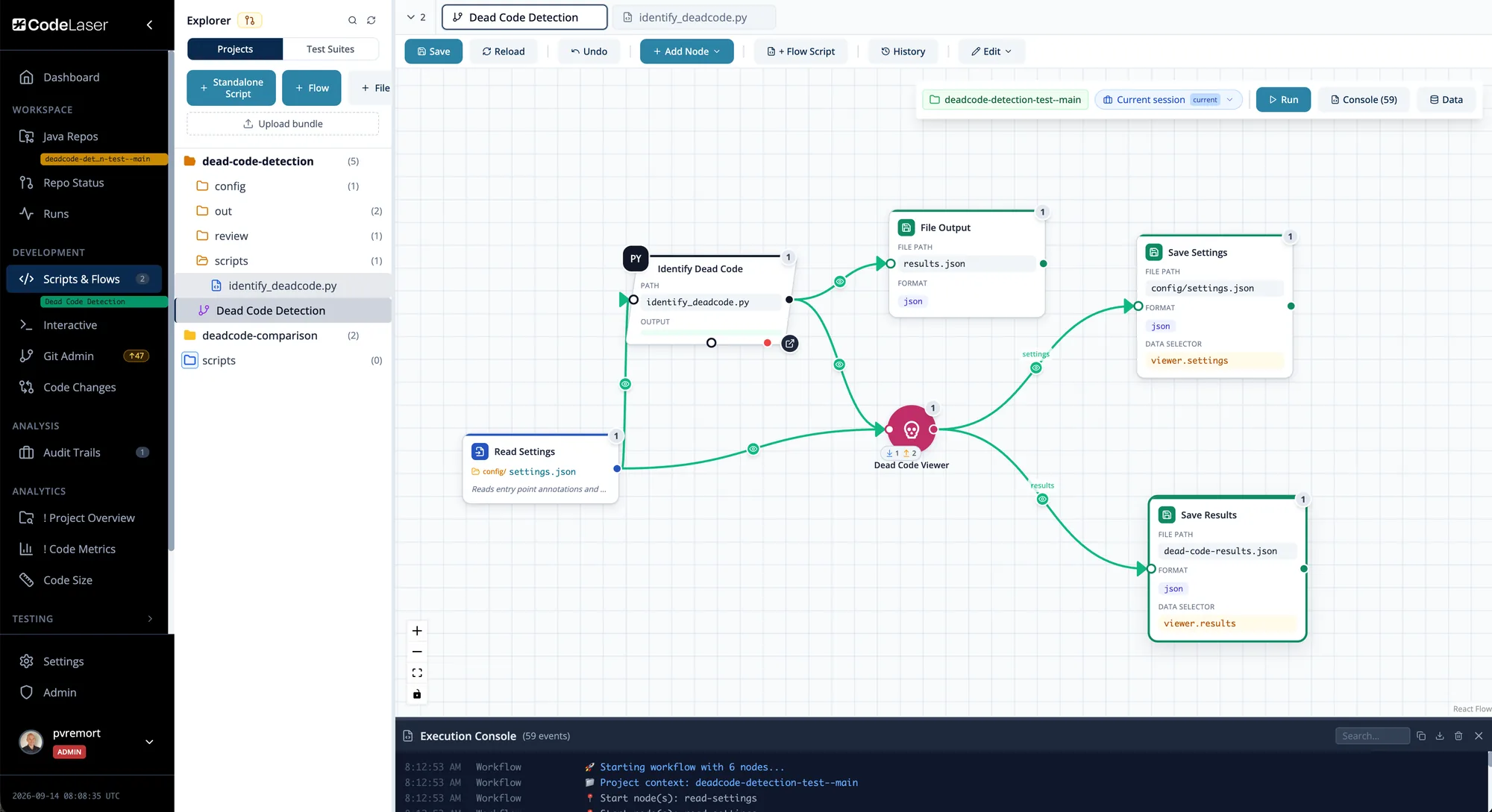
Every analysis and every refactoring is an operation: Python calling the engine, against the code model. Your agent writes them; you keep them, version them and hand them to someone else.
Operations compose into plans: named steps with live results that you can re-run. The plan you built in a session is the same one that runs in CI.
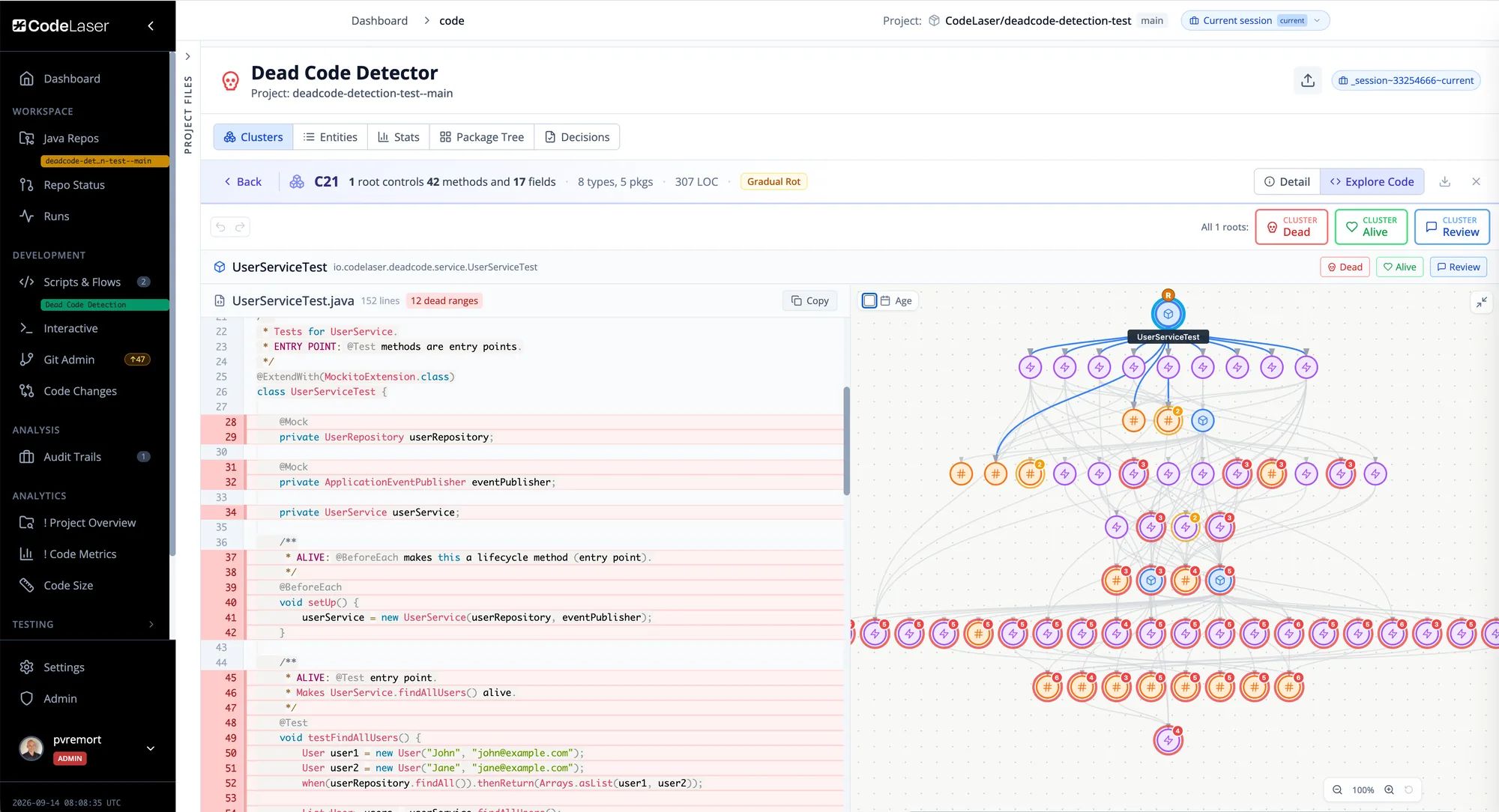
And where the answer needs a person, there is one. The workbench shows the insight behind a finding — the graph, the call sites, the source — so you confirm what is genuinely dead before anything is removed.
Structural rules
Rules that catch technical debt creeping back and can propose a valid fix.
Cleaning up a codebase is only half the job. Without a check, the tangles, the dead code and the oversized classes grow back, one pull request at a time. A structural rule catches that on the pull request that brings it in, while it is still one change. The rule can carry a plan that repairs it, and because the operations are generic over the types they act on, that plan still proposes a valid change against the code as it stands rather than the version the rule was written for.
When one appears, the pull request names the edge that caused it and the move that removes it.
The offending import is flagged, with the change that fixes it.
New unreachable members are listed on the PR with a removal plan attached.
When it does, a split is proposed against the shape the class has today.
Every push and every pull request, as a check on the branch.
The rule that tripped, and the edge, import or member responsible.
A repair plan, if the rule has one, worked out against today’s code.
Open source
maddi
The analyzer at the core of the engine’s static analysis is open source. It works out what every method modifies and how close every type is to immutable, in Java and Kotlin.
About maddimaddi computes a level of immutability for every type, because real code is rarely deeply immutable.